
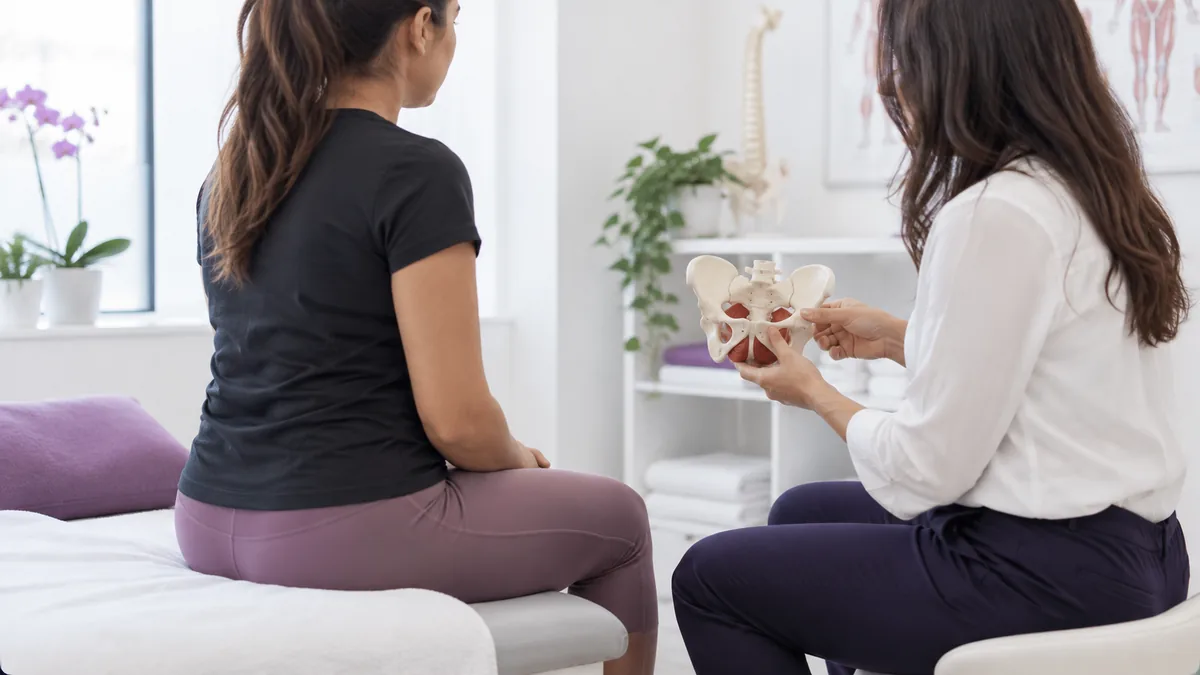
Physiotherapy will not remove endometriosis, but it treats a real part of the pain that surgery and medication often leave behind: the pelvic floor and abdominal muscles that tighten around a painful pelvis and keep hurting on their own. A 2026 systematic review in Pain Medicine found physiotherapy reduced pain scores in women with endometriosis-associated pelvic pain, with the strongest effect from treatment applied directly to the pelvis rather than general exercise alone.
This happens because chronic pelvic pain trains the nervous system to protect the area, and the pelvic floor muscles respond by staying switched on. That guarding pattern does not resolve on its own once the endometriosis lesions are treated. It has to be assessed and treated as its own problem, alongside gynaecological care, not instead of it.
If your pain continues after diagnosis, after starting hormonal treatment, or after excision surgery, that is a reasonable time to ask for a pelvic health physiotherapy assessment rather than assuming nothing more can be done. A GP or gynaecologist can refer you, specialist NHS centres such as the Oxford Endometriosis CaRe Centre describe physiotherapy as part of a multidisciplinary pathway, or you can self-refer to a specialist clinic directly. The rest of this article covers why the pain persists at a tissue and nervous-system level, a self-check for whether muscle guarding is contributing to your symptoms, what the research on physiotherapy for endometriosis actually shows, and when pain needs same-day medical attention rather than a physiotherapy appointment.
Why endometriosis pain often outlasts the disease itself
Endometriosis pain and pelvic floor muscle overactivity feed each other, and treating only one side of that loop leaves pain behind.
Endometriosis lesions cause direct inflammatory pain, but they also sit near or on structures that share nerve pathways with the pelvic floor, bladder and bowel. Persistent pain signals from the pelvis train the spinal cord to become more sensitive over time, a process called central sensitisation. The pelvic floor and deep abdominal muscles respond to this ongoing pain signal by holding tension, much like a shoulder that stays hunched after a whiplash injury long after the original tissue has healed. Over months or years this guarded, overactive pelvic floor becomes a pain generator of its own, causing deep pain with penetration, a dragging ache, or bladder and bowel symptoms that persist even when a laparoscopy shows the disease has been successfully excised. This is why some women are told their surgery was “successful” and still hurt: the surgery treated the lesions, not the muscle guarding the surgery caused the body to build around them. Physiotherapy targets that second, muscular layer directly, using internal and external manual techniques to release the guarding pattern and retrain the pelvic floor to relax as well as contract.
A self-check: is muscle guarding part of your pain?
This is not a diagnostic test and does not replace assessment, but it helps you describe your pattern accurately when you do seek help.
| Sign | What it may suggest |
|---|---|
| Pain is worse with deep penetration, tampon insertion, or a smear test, rather than constant regardless of activity | Overactive pelvic floor is likely contributing alongside the endometriosis |
| You notice you clench, brace, or hold your breath when pain starts | Active muscle guarding pattern, a physiotherapy-treatable target |
| Pain has a burning, tight or “closed” quality rather than only a cramping or sharp quality | Nervous system sensitisation and muscle involvement are common in this pattern |
| Bladder urgency, incomplete emptying or bowel symptoms have developed alongside the pelvic pain | Pelvic floor coordination is likely affected, not only the disease itself |
| Sitting for long periods, cycling or certain yoga positions reliably increase pain | Suggests a mechanical, muscle-loading component worth assessing directly |
If two or more of these apply, a pelvic health physiotherapy assessment is a reasonable next step, run alongside whatever gynaecological treatment you are already having, not as a replacement for it.
What the evidence actually says
The research on physiotherapy for endometriosis is still a young field, and it is honest to say so rather than overstate it.
A 2026 systematic review of seven controlled studies, published in Pain Medicine, found physiotherapy reduced endometriosis-associated pelvic pain overall, and that locally applied techniques, meaning hands-on pelvic and abdominal work rather than generic exercise programmes, produced the largest reductions in pain scores. The review’s authors were clear that the number of included studies was small and the interventions varied considerably between trials, so the size of the benefit should be read as encouraging rather than definitive.
A 2022 review in the International Journal of Environmental Research and Public Health looked more broadly at physiotherapy approaches used in endometriosis care, including manual therapy for pelvic floor and visceral tissue, post-surgical scar management, and exercise for its anti-inflammatory effect. It found physiotherapy is consistently used as a complementary treatment alongside medical and surgical care rather than a substitute, and flagged that many individual techniques still lack large, well-designed trials, meaning treatment choices are often guided by clinical reasoning and patient response as much as by trial evidence.
Taken together, the evidence supports physiotherapy as a genuine part of endometriosis pain management, particularly for the muscular and nervous-system component of the pain, while being honest that it is not a cure for the underlying disease and the evidence base is still developing.
When to seek same-day medical care instead of booking physiotherapy
Some symptoms need urgent medical assessment rather than a physiotherapy appointment. Contact your GP, NHS 111, or A&E the same day if you experience:
- Sudden, severe pelvic pain that is different from your usual pattern, especially with fainting, vomiting or a fever
- Heavy vaginal bleeding that soaks through a pad or tampon within an hour
- Pain with a positive pregnancy test, or any possibility of pregnancy with severe one-sided pain
- New loss of bladder or bowel control, or numbness in the saddle area
- Signs of infection after recent gynaecological surgery, such as fever, wound discharge or worsening pain rather than gradual improvement
None of these should wait for a routine appointment of any kind.
What a physiotherapy assessment for endometriosis-related pain actually involves
Assessment and treatment are tailored to what is driving your specific pain pattern, not a fixed protocol applied to everyone with the same diagnosis.
At PhysioReform, an initial pelvic health assessment for endometriosis-related pain typically runs around an hour, longer than a standard physiotherapy appointment, because it needs to cover your surgical and symptom history, external and (with your consent) internal assessment of pelvic floor muscle tone and tenderness, and screening for bladder, bowel and central sensitisation features before any hands-on treatment begins. Treatment commonly combines manual therapy to release overactive pelvic floor and abdominal wall tension, breathing and down-training work to reduce the guarding pattern, and, where surgery has been performed, scar and adhesion mobilisation once the wound has fully healed. Fara Sonday, who leads this work at the Central London clinic, is a Pelvic Floor Society and POGP registered specialist with over 20 years’ clinical experience across pelvic health, oncology and MSK physiotherapy, which matters here because endometriosis pain frequently overlaps with bowel, bladder and post-surgical presentations rather than sitting in one clean category.
Common questions
Can physiotherapy cure endometriosis?
No. Physiotherapy does not remove endometriosis tissue and is not a substitute for gynaecological diagnosis or treatment. It targets the pelvic floor muscle guarding, scar tissue and nervous-system sensitisation that often develop around the disease and can continue causing pain even after medical or surgical treatment.
Do I need a diagnosis before starting physiotherapy?
A formal diagnosis is not required to start. Many women begin physiotherapy while investigations are ongoing, since pelvic floor overactivity can be assessed and treated regardless of whether endometriosis has been confirmed by laparoscopy or imaging.
Will an internal pelvic examination be part of every session?
Internal assessment is offered where it is clinically relevant and only ever with your informed consent, and you can decline it at any point. External assessment, breathing work and education can still provide useful treatment on their own.
How soon after excision surgery can physiotherapy start?
This depends on your surgeon’s guidance and wound healing, but external work such as breathing retraining and gentle scar desensitisation can often begin within a few weeks, while internal and deeper scar mobilisation typically waits until full healing is confirmed.
Does physiotherapy help with the bladder and bowel symptoms that come with endometriosis?
Often, yes, when those symptoms relate to pelvic floor coordination rather than the disease process itself. Assessment aims to identify whether urgency, incomplete emptying or bowel symptoms are linked to muscle guarding, which physiotherapy can address directly.
Is pain during sex from endometriosis always about the disease itself?
Not always. Deep pain with penetration can come from the endometriosis lesions, from an overactive pelvic floor guarding against pain, or, commonly, from both together, which is why a physiotherapy assessment alongside gynaecological review can clarify what is driving the pain rather than assuming.
About the author
Fara Sonday is a specialist pelvic health, oncology and MSK physiotherapist with more than 20 years’ clinical experience, HCPC and CSP registered, and a member of the Pelvic Obstetric and Gynaecological Physiotherapy (POGP) network and the Pelvic Floor Society. She sees endometriosis, pelvic pain and post-surgical patients at PhysioReform, just off Tottenham Court Road between Tottenham Court Road and Goodge Street stations. Learn more about women’s health physiotherapy at PhysioReform.
Book an assessment
If pelvic pain has continued despite treatment for endometriosis, a pelvic health physiotherapy assessment can identify what else is contributing and what can be done about it. Book an appointment at PhysioReform in Central London.